Three mobile broadband enables you to stay connected at home or on the move, with the latest dongles and Mobile Wi-Fi devices.
Dongles are designed for use in laptops and are powered by USB, while battery-powered mobile Wi-Fi devices can share internet over Wi-Fi with numerous devices at the same time.
Great value mobile broadband deals are available on Three on Pay Monthly contracts and Pay As You Go plans.
What is mobile broadband?
Put simply, mobile broadband is a way to access the internet wherever you are. Mobile broadband uses mobile networks (3G, 4G or 5G networks) to send data over the air - enabling you to browse anywhere you have a mobile signal.
Mobile broadband devices tend to be battery powered, but you can also plug some in via USB. What none of them need is mains power – however you can also get 4G and 5G home broadband if you want a device that you can leave plugged in and switched on 24/7.
Currently Three offers mobile broadband devices which utilise both 5G and 4G mobile networks. These allow you to send a huge amount of data over-the-air and enable you to stream video, download files and browse the internet at superfast speeds.
What is MiFi (Mobile WiFi)?
Mobile Wi-Fi (sometimes called mobile broadband or MiFi) refers to portable, pocket-sized devices that can broadcast a broadband connection using 5G, 4G or 3G, allowing you to connect other devices such as laptops and tablets to the internet, even if there’s no fixed broadband or a power supply available.
Much like a phone or a tablet, mobile Wi-Fi devices can be bought outright or on a Pay Monthly contract.
What are the advantages of mobile broadband?
Access the internet anywhere
Mobile broadband works anywhere you have a mobile signal, giving you ultimate flexibility. Whereas a fixed broadband connection only works as far as your Wi-Fi connection will reach - and that is not very far!
No need for a landline
You might be used to needing a landline for your broadband, but with mobile broadband that’s not necessary, so you can save a significant amount of money. You also don’t need a landline for 4G and 5G home broadband.
Great value
Mobile broadband connections offer great value, with Three plans starting from just £22 a month. The fact that you do not need a landline keeps the cost significantly lower than fixed broadband connections.
How fast is Three mobile broadband?
Three’s 5G mobile broadband promises speeds of up to 1Gbps, though real world speeds on Three’s 5G network are more likely to average something in the region of 200Mbps based on third-party tests.
Average 4G speeds are a lot lower at around 22Mbps going by tests, with the Three 4G MiFi theoretically being capable of up to 300Mbps speeds.
So in all cases the Three 5G MiFi should be a lot faster, but even its 4G mobile broadband service is speedy enough to stream Full HD videos on Netflix.
However, coverage varies significantly from place to place, so it is always best to check coverage in your area, as this can affect speeds.
Why choose Three mobile broadband?
There are several reasons to choose Three mobile broadband:
4G and 5G at no extra cost - all plans come with 4G and 5G at no extra cost, but if you don’t have a 5G device or aren’t in a 5G area you can still make use of Three's superfast 3G and 4G networks.
Award winning – Three has won a number of awards, including being voted the Best Network for Data at the Uswitch Awards 2022 and the Fastest 5G Network award at the Ookla Speedtest Awards 2023.
Unlimited data - Three offers mobile broadband plans with unlimited data, so you can browse and stream as much as you want.
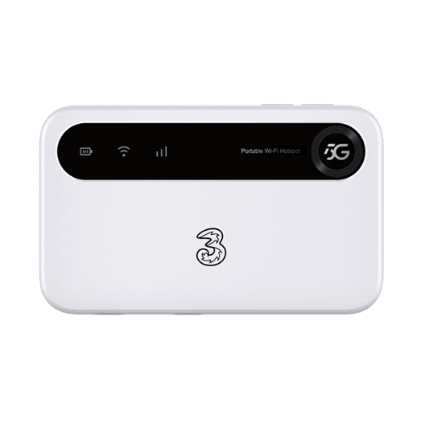
At the time of writing, Three offers just two MiFi devices, but they’re good ones. Its fastest, dubbed the Three 5G MiFi U50, supports download speeds of up to 1Gbps, can get up to 32 devices online at once, and has a sleek design and good battery life.
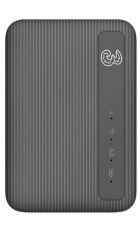
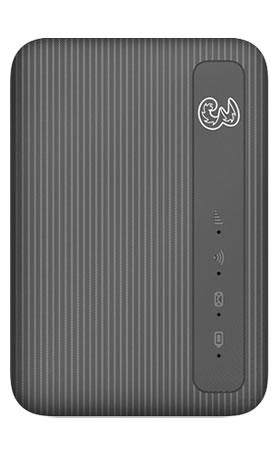
There’s also the Three 4G MiFi, which supports speeds of up to 300Mbps and can get up to 16 gadgets online.
If you don't need internet everywhere, there is the option of Home Broadband which requires mains power as opposed to Mobile Broadband which works via battery power. Our Three 5G Hub review found it to be a very fast performer and our recommended choice for anyone needing Home Broadband.
What is a Pay Monthly MiFi contract?
A Pay Monthly mobile Wi-Fi contract is similar to a phone contract in that it incurs a fixed monthly fee for a set period of time (1, 12 or 24 months). For that money you get not just the mobile Wi-Fi device but also a monthly data allowance.
The advantage of taking out a pay monthly contract is that you don't have to pay as much upfront for your MiFi device, or in many cases anything at all, which can make it a lot more affordable if you don’t have a lot of money to spare.
All contracts come with an inclusive data allowance to use each month and they are taken out over a choice of 24 months, 12 months or just 30 days, after which you are free to switch to a SIM Only deal or Pay As You Go.
If you don’t already have a mobile broadband device than a Pay Monthly contract is often the best option.
Frequently Asked Questions
What is the difference between dongles and mobile Wi-Fi (MiFi)?
A dongle plugs into the USB port on a laptop or desktop PC to provide internet over mobile broadband. Generally, they only provide internet to the device they are plugged into and are small, discreet and require no installation.
Mobile Wi-Fi (or MiFi) units are battery-powered devices that can share a single mobile connection with multiple devices over Wi-Fi. That means you can use them wirelessly and connect almost any internet enabled device. It also means you can share a single 3G, 4G or 5G connection with multiple Wi-Fi devices at the same time, including your tablet, desktop PC or games console.
What is the difference between 3G, 4G and 5G mobile broadband?
The difference between 3G, 4G and 5G mobile broadband mostly comes down to speed, with 4G being up to five times faster than standard 3G, and 5G being far faster still.
At the time of writing, Three offers both 5G and 4G mobile broadband devices. With 4G you can stream Full HD videos, load sites in an instant, play online games smoothly, have video calls, and more. Three’s 4G mobile broadband devices are competitively priced too, and offer impressive specs.
But if you want the ultimate mobile broadband speeds then you should go for 5G mobile broadband, which can rival fibre broadband for speeds.
Can I get a mobile broadband SIM Card on its own?
Absolutely, Three offers a range of SIM Only plans for mobile broadband devices. They are known as data only SIMs and come bundled with an included data allowance per month, topping out at unlimited data. Simply pop one into your existing dongle or MiFi device and away you go!
Newsletter
Be the first to hear about the latest devices and get news of breaking deals before anyone else.




.png)